
Guide AI Lead Tools
AI Receptionist vs
Answering Service vs
Hiring Someone
An AI virtual receptionist is software that answers your calls, a live answering service is people doing the same job from a call centre, and hiring someone puts a person in your business full time. They cost wildly different amounts, and the gap is not really about technology. It is about whether the call needs judgement.
Most people arrive at this comparison after getting two quotes that made no sense next to each other. One came in around fifty dollars a month, the other closer to four hundred, and both were described as “someone answering your phone.”
Both quotes were probably fair. They were selling different things, and once you can see what each option is actually charging you for, the choice usually makes itself.
What you are actually buying in each case
Every option here bills you for one of three things: minutes of software, minutes of a person’s attention, or a person’s presence in your business. That is the whole comparison, and almost every other difference follows from it.
Software sells you capacity. An AI receptionist can take five calls at once at three in the morning, and the marginal cost of the sixth call is close to nothing. That is why it is cheap and why it never gets tired. It also cannot tell that the caller is furious.
An answering service sells you judgement, by the minute. Real people, trained on a script, working from a call centre. They handle the messy call. They also cost what people cost, and you are paying for their time whether the call needed a human or not.
An employee sells you presence. Someone who knows your regulars, notices things, and does the other work between calls. Nothing else on this list does that, and nothing else costs that much either.
Once you see it that way, the question stops being “which is best” and becomes “how many of my calls actually need judgement.” That is a question only you can answer, and it is worth spending ten minutes on before you spend anything else.
What is the difference between an AI receptionist and an answering service?
An AI receptionist is software and an answering service is staffed by people. That single difference produces everything else: the price gap, the availability, the consistency, and where each one falls over.
Software answers instantly, every time, at any hour, and says exactly what it was taught. It does not have a bad day and it does not put anyone on hold, but it also cannot improvise. An answering service can improvise, take a genuinely unusual message and calm someone down, but you are paying for a person’s minutes and there is a limit to how well anyone knows your business from a script.
The hybrids in the middle exist because most businesses want a bit of both. Smith.ai pairs AI with live agents from $300 a month for 30 calls, which is roughly what you would expect from something carrying both cost structures.
The cost per minute nobody puts side by side
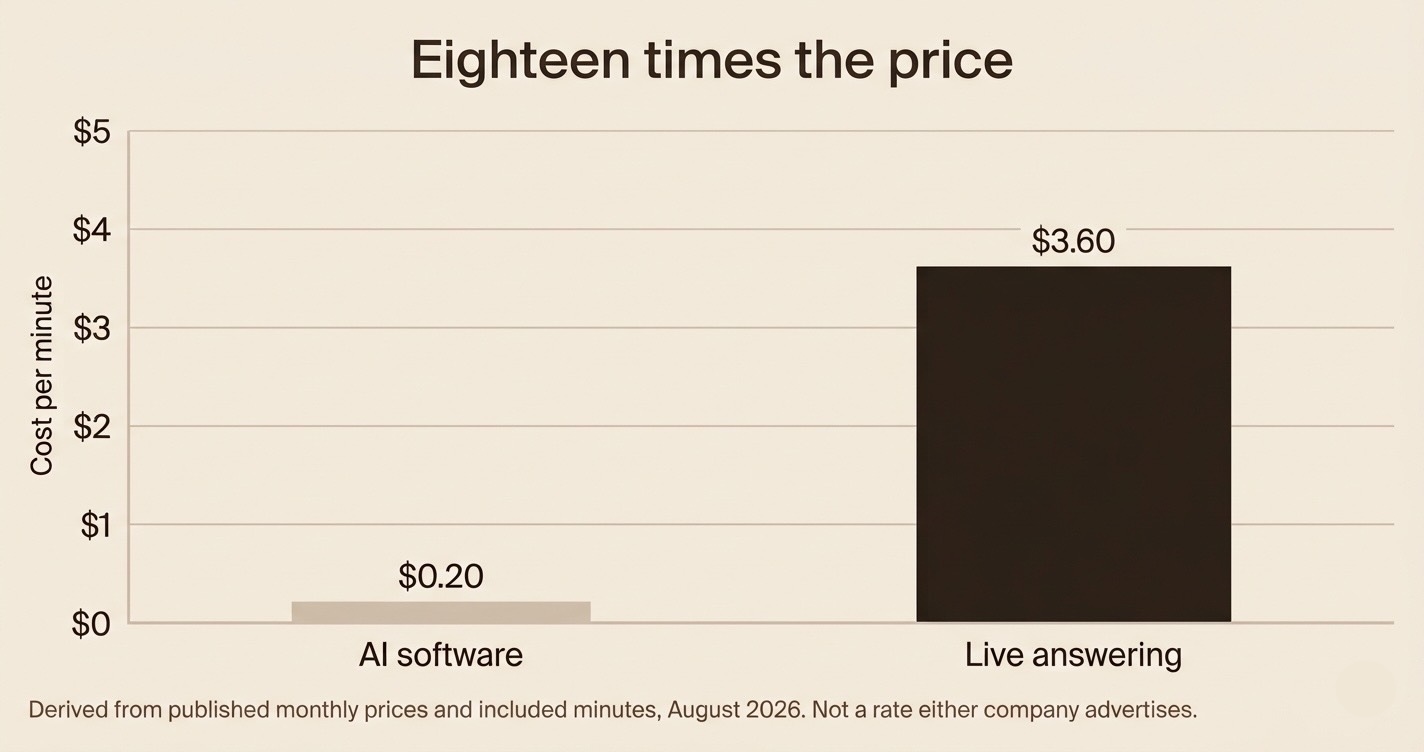
Here is the comparison that actually settles this, and it is strange that nobody publishes it: what a minute of answered phone costs under each model.
Published prices, checked August 2026. The monthly figures and included minutes are what each company publishes; the per minute column is our arithmetic on those two numbers, not a rate any of them advertises.
| Option | Plan | Monthly | Included | Roughly per minute |
|---|---|---|---|---|
| AI software | Rosie Professional | $49 | 250 minutes | $0.20 |
| AI software | Rosie Growth | $299 | 2,000 minutes | $0.15 |
| AI, human backed | Smith.ai Starter | $300 | 30 calls | billed per call, $11.50 after |
| Live answering | Ruby, 50 minutes | $250 | 50 minutes | $5.00 |
| Live answering | Ruby, 200 minutes | $720 | 200 minutes | $3.60 |
A minute of human answering costs roughly twenty times a minute of AI answering. That is not a scandal and it is not anybody overcharging. It is what it costs to have a trained person sitting there ready for your call, and Ruby is upfront about it, publishing plans openly and stating there are no hidden setup or onboarding fees.
The number matters because it reframes the decision. You are not choosing between cheap and expensive. You are deciding what share of your calls genuinely need a human, and buying that share at twenty times the price while the rest gets handled at software prices. Most small businesses, in our experience, need far less judgement on the phone than they assume, because most calls are “are you open”, “how much roughly”, and “can you come Tuesday”.
Is an AI virtual receptionist better than a live one?
For repetitive calls, yes, and it is not close. For calls that need someone to read the situation and decide something, no, and pretending otherwise is how businesses end up embarrassed.
The honest split looks like this. AI wins on availability, on cost, on consistency, and on never losing a message. People win on anything unusual, anything emotional, and anything where the right answer depends on context nobody wrote down. If your phone is mostly bookings and basic questions, software covers it. If your phone is mostly consultative from the first hello, it does not, and no amount of setup fixes that.
Should I hire someone instead?
Only if you need the rest of the job. A receptionist who exists purely to answer the phone is the most expensive way to solve this problem, but a receptionist who also handles scheduling, invoicing, walk-ins and everything else is not really a phone expense at all.
That is the test we would apply. Write down what the person would do between calls. If that list is long and genuinely valuable, hire, and treat the phone as a bonus. If the list is short, you are buying a very expensive phone answering service and one that goes home at five and takes holidays.
We have not published a salary figure here on purpose. Wages vary enormously by region and we could not verify a current national number from a primary source while writing this, so quoting one would be guessing dressed up as research. Your local job boards will tell you more than a national average would anyway.
Can I use more than one?
Yes, and it is often the right answer. The common setup is AI first, with a person as the escape hatch, so software handles the volume and a human catches whatever it cannot.
That is what most of the hybrid products are doing internally, and you can assemble it yourself: AI answers, and anything it flags gets transferred to you, to a staff member, or to an answering service you keep on a small plan. You end up paying software prices for the bulk of your calls and human prices only for the ones that earned it.
The setting that makes this work is the handoff rule, and getting it wrong is the most common way these deployments disappoint people. We went deeper on that in how an AI phone receptionist works. We have written about how the escalation setting decides whether any of this works.

What we would actually pick, and when we would tell you to hire
If we were choosing for a small local business today, we would start with AI, keep a human escape hatch, and revisit in three months with real call data instead of guesses. That is the cheapest way to find out what your phone actually does.
If that is the direction you are leaning, the next question is which one, and we wrote a buyer’s guide to picking an AI receptionist for a small business covering the three things worth comparing.
And we would tell you to hire a person, not buy software, in two situations. If the role is genuinely broader than the phone, hire, because you are solving the wrong problem with a bot. And if your business runs on relationships where being recognised matters, hire, because software cannot recognise anyone and faking that costs you more goodwill than the savings are worth.
The one thing we would not do is choose based on the monthly figure. A cheap system that mishandles your best caller is not cheap, and an expensive one answering questions your website should have answered is not good value either. Work out what your calls actually are first. The rest is arithmetic, and our lost revenue calculator or the breakdown of what these actually cost will do that part with you.
There is a fourth option this comparison has not given you, and it is the one we run, so treat it as a disclosure rather than a recommendation. Most AI software hands you a dashboard and wishes you luck. Black Peak Studio builds the thing around your business instead: we write what it says, decide who it interrupts and when, and set the handoff rule with you before it ever answers a live call. That is the difference between the metered software row in the table above and something that sounds like your business on the first ring.
What it buys you is simple enough. Every call gets answered, at any hour, including the ones that arrive while you are already on the phone, so whether a lead reaches you stops depending on whether you were free. And because we are in Kalispell rather than a call centre somewhere, we will work to whatever budget you have, from answering the phone after hours to a full setup wired into your calendar and CRM. If the honest answer is that you need a person, we will tell you that instead.
If you want a second opinion on which way your phone points, take a look at how our AI voice receptionist works or get in touch. We are just as happy telling you to hire someone.
One thing worth doing before you choose any of the three: hear what the software option actually sounds like. Our free demo builds one around your business in about thirty seconds. Judging the voice yourself beats reading anybody’s comparison, including this one.