
Guide AI Lead Tools
How Much Does an AI Receptionist Cost?
An AI receptionist costs roughly $25 to $300 a month, and the entry price tells you almost nothing useful. What actually decides your bill is the pricing model, and there are five of them in common use, which is why one quote looks ten times cheaper than another for what sounds like the same thing.
You are probably here because you got a quote that seemed reasonable, or one that seemed mad, and you have no way to tell which. That is a fair place to be stuck. This market prices the same product five different ways and almost nobody explains the difference.
So here are the real published numbers, checked in August 2026, what makes a bill go up, and the three questions worth asking before you sign anything.
The five ways these get priced, and why comparing them is meaningless
Every AI receptionist bills on one of five models, and a headline price is only comparable to another headline price on the same model. Put them side by side without sorting that out first and you will pick the wrong one.
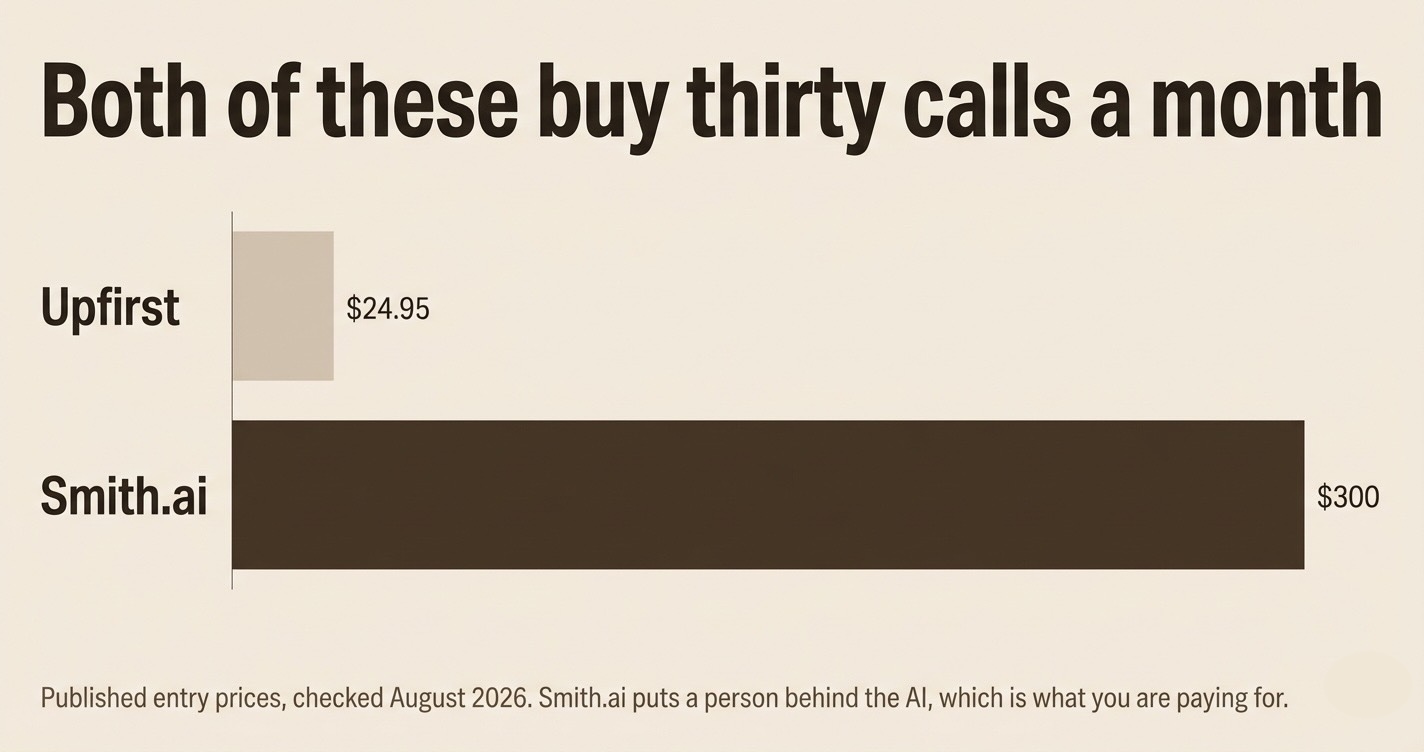
Per call. You get an allowance of calls and pay a penalty rate past it. Upfirst starts at $24.95 a month for 30 calls, then $1.50 per additional call.
Per minute. You buy talk time instead of conversations, so a few long calls cost you the same as many short ones. Rosie starts at $49 a month for 250 minutes.
Per unique customer. You pay for how many different people call you, not how much they talk. Goodcall starts at $79 a month per agent covering 100 unique customers, then $0.50 each, and states plainly that it does not charge for calls, minutes or tokens.
Per call, with humans behind it. The AI answers and a real person catches what it cannot. Smith.ai starts at $300 a month for 30 calls, then $11.50 per call after. Twelve times Upfirst's entry price for the same thirty calls, because you are buying people, not software.
Quote only. Some of the biggest names publish nothing at all. RingCentral's AI Receptionist page lists capabilities and a phone number for sales, with no pricing anywhere. Worth knowing that the product Google's AI Overview cites first is one you cannot price without a sales call.
Published entry prices, checked August 2026:
| Provider | From | What that covers | Going over |
|---|---|---|---|
| Upfirst | $24.95/mo | 30 calls | $1.50 per call |
| Rosie | $49/mo | 250 minutes | not published |
| Goodcall | $79/mo per agent | 100 unique customers | $0.50 per customer |
| Smith.ai | $300/mo | 30 calls, human backed | $11.50 per call |
| RingCentral | not published | contact sales | not published |
Read the last column before the first one. That is where the money actually is.
Is there a free AI receptionist?
Not a real one. You will find free trials, and you will find free tiers on chat widgets, but nothing that answers your phone properly for nothing, because every call costs the provider money in AI usage and phone minutes.
What "free" usually means in this market is a trial of a paid plan, or a free chat widget bundled with a paid voice product. Rosie, for instance, includes website chat free on all plans while the voice service is paid. That is a reasonable offer. It is just not a free receptionist.
If your budget is genuinely zero, you are better served by fixing your voicemail greeting and turning on a missed call text back than by hunting for a free AI. Both cost nothing and both recover some of what you are losing.
What actually drives the price up?
Call volume drives most of it. Everything else is secondary, and it comes down to how much the receptionist has to know, how many places it has to send people, and how much of that the provider treats as an upgrade rather than as part of the job.
Four things move the number:
Volume. Every model above charges more as you get busier. It is the single biggest variable and the one you control least.
Integrations. Booking into a calendar, writing to a CRM, taking a deposit. Each connection is real setup work, and plenty of platforms put the useful ones behind a higher tier.
Complexity. One service and one calendar is cheap. Five service types, three staff calendars, and different rules after five o'clock is not.
Setup. Somebody has to teach it your business, and the mechanics of a call show why that is the part worth paying for. Either you spend those hours or you pay someone to, and a system nobody taught properly is the most expensive option on the list, because it fails quietly and you find out from the customer you lost.
Worth saying where we stand, since three of those four are places the industry likes to charge again. We quote one fixed monthly rate and it does not move. The prompt is written from scratch for your business with no cap on how much it can be taught, and the integrations your voice agent needs are part of the build rather than an add on, as long as we can work with the CRM you already use. If your calls get more complicated next quarter, the number stays the same.
The number that decides whether any of this is worth it
None of the prices above mean anything until you know what one job is worth to you. That is the only figure in this decision that is genuinely yours, and it is the one almost nobody works out before shopping.
Start there, because it usually ends the argument on its own. If an average job is worth five hundred dollars, one recovered call a month pays for almost every system on this page and leaves change. If it is worth five thousand, one recovered call a year does. Most owners are comparing monthly fees against each other when they should be comparing them against a single job.
The rest of the arithmetic is unglamorous. Take that job value. Multiply by the share of callers who would have booked. Then multiply by how many calls you miss in a month, honestly, including evenings, weekends, and the ones that came in while you were under a sink. If that number is bigger than the quote, the quote is cheap.
If you would rather not do it on paper, we built a lost revenue calculator that runs the same sum. It asks for your leads, your booking rate, your close rate and what an average sale is worth, then shows what follow up gaps, dormant contacts and no shows are costing you over a year. Two minutes, and you leave with your own number instead of somebody else's average.
And if you are down to comparing named products, our buyer's guide to picking one for a small business covers what actually separates them.
For a sense of scale before you count your own, the best recent figure we could find comes from call tracking data rather than a survey. Invoca, which measures inbound calls for a living, reports that 27% of calls to home services businesses are not answered, and that fewer than 3% of the people pushed to voicemail leave a message. Roughly one call in four goes nowhere, and almost none of those callers give you a second chance to notice.
Two honest caveats. Invoca sells software that helps with this, and they do not publish the sample size behind that number. Treat it as a reasonable order of magnitude, not as your number.
Which is the actual point. You will see "62% of business calls go unanswered" quoted everywhere, usually with no date attached. It traces back to a January 2016 study that monitored 85 businesses for 30 days, and a decade-old sample that small should not be deciding anything for you. Spend twenty minutes with your own phone log instead. Whatever you find there is worth more than every statistic on this page.
The saving nobody puts a number on
There is a second return here and it does not show up in revenue at all. A decent AI receptionist does not just catch the call, it asks what the job is, roughly when, and whereabouts, then hands you that. Spam and robocalls never reach you.
So you stop ringing back a list of unknowns and start ringing back a short list of real ones. If half your callbacks currently turn out to be price shoppers, wrong-area enquiries or somebody selling you SEO, that is hours a month you get back, and it is worth putting a rough figure on before you decide anything. Nobody sells this benefit well because it is harder to chart than lost revenue, but owners tend to notice it first.
Is an AI receptionist cheaper than hiring someone?
Yes, by a wide margin, and that is the easy part of the comparison. A part time receptionist costs more per month than every software option listed above, and they go home at five.
The harder question is whether cheaper is what you need. A person handles the awkward call, reads the room, and remembers that the caller's last job went badly. Software does not. If most of your calls are "are you open" and "can I book Tuesday", the AI wins comfortably. If most of them need judgement from the first hello, you are comparing the wrong two things, and we have written more about how these actually work and where they fall short.
There is a third option people forget, which is a live answering service: real people, but working from a call centre rather than sitting in your business. It costs somewhere between the two, and we put all three side by side, down to what a minute of answered phone costs under each.
What should I ask before I sign anything?
Three questions, and the answers matter more than the monthly price. What happens on the first call past my allowance, who holds the AI provider account, and what does it do with a call it cannot handle?
The first tells you what a good month costs. The second tells you whether anyone is adding a margin to your usage, and whether you can see the real number. The third is the one that decides whether your customers have a good experience or a maddening one.
For what it is worth, here is how we handle the middle one. Our clients open their own AI provider account and get billed directly, at cost, with nothing added by us. There is no allowance to blow through and no penalty rate, because there is no bundle. The trade is honest: a pass through bill moves month to month, so if you need one identical number regardless of volume, this is not the right shape for you. What you get instead is that nobody takes a cut of your call volume, and a busy month never turns into a surprise invoice.

What we would actually spend it on
If money is tight, do not buy the most expensive system. Buy the cheapest one that handles your two most common calls properly, and spend the difference on setting it up well.
We say that knowing it argues against selling you more. The failure we expect to see most over the next couple of years is not businesses buying too little AI, it is businesses buying a capable system, giving it an hour of attention, and concluding the technology does not work when what actually failed was the setup. A cheap receptionist that knows your business beats an expensive one that does not, every time.
And if you work out that you are not missing enough calls to justify any of this, that is a good outcome. Keep your money.
That advice is also how Black Peak Studio works, so it is worth saying plainly. We are not trying to sell every business the biggest build. We start from what your phone actually does and scope to the budget you have, whether that is covering the hours you are on a job and nobody is at the desk, or a full setup answering around the clock and booking straight into your calendar. The point of any of it is the same: a caller who was ready to hire you should never land in voicemail because it was six in the evening or you already had the phone to your ear.
If you want a hand doing that arithmetic for your business, including hearing that the answer is no, take a look at how our AI voice receptionist works or get in touch.
Working out what it is worth to you costs nothing either. Our free demo builds an agent for your business in about thirty seconds so you can hear exactly what you would be paying for before anyone quotes you a number.