Guide AI Lead Tools
Best AI Receptionist for Small Business
The best AI receptionist for a small business is the one that answers every call in your own voice, books the job or captures the lead, and does not punish you for a busy month. There is no single product to crown, because the right pick depends on how many calls you actually miss, what one job is worth to you, and how you want to be billed when the phone gets loud.
Most owners land here after a long day. You finished a job, wiped your hands, checked your phone, and there were three missed calls and no voicemails. Those were probably not wrong numbers. In a small local business, a call you did not pick up is usually someone who was ready to book and has already moved on to the next name on Google.
So this is not a ranking. It is the short list of things that actually separate a good AI receptionist from an expensive one, the single billing line that costs owners the most, and how to tell which one fits the way your phone really rings.
“Best” is a fit question, not a leaderboard
Before you trust any “best AI receptionist” list, including this one, look for the affiliate disclosure. Plenty of those pages earn a commission on what they rank. That is not a scandal, it is how they make money, but it is worth knowing before you treat a ranking as neutral, and it helps explain why they all quietly disagree with each other. A tool that is perfect for a law firm taking twenty detailed intake calls a day is the wrong tool for a two truck landscaping crew that just needs the phone answered while everyone is on a job.
The honest version of “best” is a match. Three things decide it, and everything else is detail: does it answer every call instantly, at any hour, without fail; does it sound like your business instead of a generic robot; and how does it bill you when your call volume jumps. Get those three right and the brand name on the box barely matters.
We will take the billing one head on further down, because it is the one that quietly costs the most.
The number that decides this is your average job value
Before you compare a single feature, work out what one job is worth to you. A plumber’s average ticket is not a hair salon’s, and a roofer’s is not a dog groomer’s, so no generic advice can do this math for you. Take your average job value and multiply it by the calls you miss in a normal week. That number, not the monthly price, is what you are actually deciding about.
For a lot of local businesses the arithmetic is stark. If your average job is worth a few hundred dollars, recovering one or two missed calls a month covers the entire cost of almost any receptionist on the market. The rest of the recovered calls are profit you were previously handing to whoever picked up on the second ring.
If you would rather not do it on paper, our lost revenue calculator runs the same sum from your own numbers in about two minutes.
In our experience, owners who start from job value choose very differently from owners who start from the price sheet. One is buying back lost revenue. The other is shopping for the cheapest monthly line, which, as you are about to see, is exactly how people end up on the wrong plan.

How do I choose an AI receptionist for my small business?
Choose on three things, in this order: whether it answers every call instantly at any hour, whether it sounds like your business rather than a generic bot, and how it bills you when your call volume spikes. Calendars, text follow up and CRM sync all matter, but in our experience they are table stakes now, not the deciding factor.
Answering is the whole job, so test it first. (Here is what happens on a call, start to finish.) A receptionist that handles five calls at once at two in the morning is doing something no human and no voicemail can. Voice is the next filter: your regulars can tell a canned bot in three seconds, so the one that greets callers the way you would is worth more than one with a longer feature list. If you are still getting your head around what these tools actually are, our guide on what an AI receptionist is covers the groundwork. Then comes billing, which almost nobody checks until it is too late.
Read the overage line before you read the monthly price
Here is the line that costs small businesses the most, and it is never the headline number. It is what happens after your included calls run out. Vendors compete loudly on the monthly price and stay quiet about the rate underneath it, because that rate is where a busy month is won or lost.
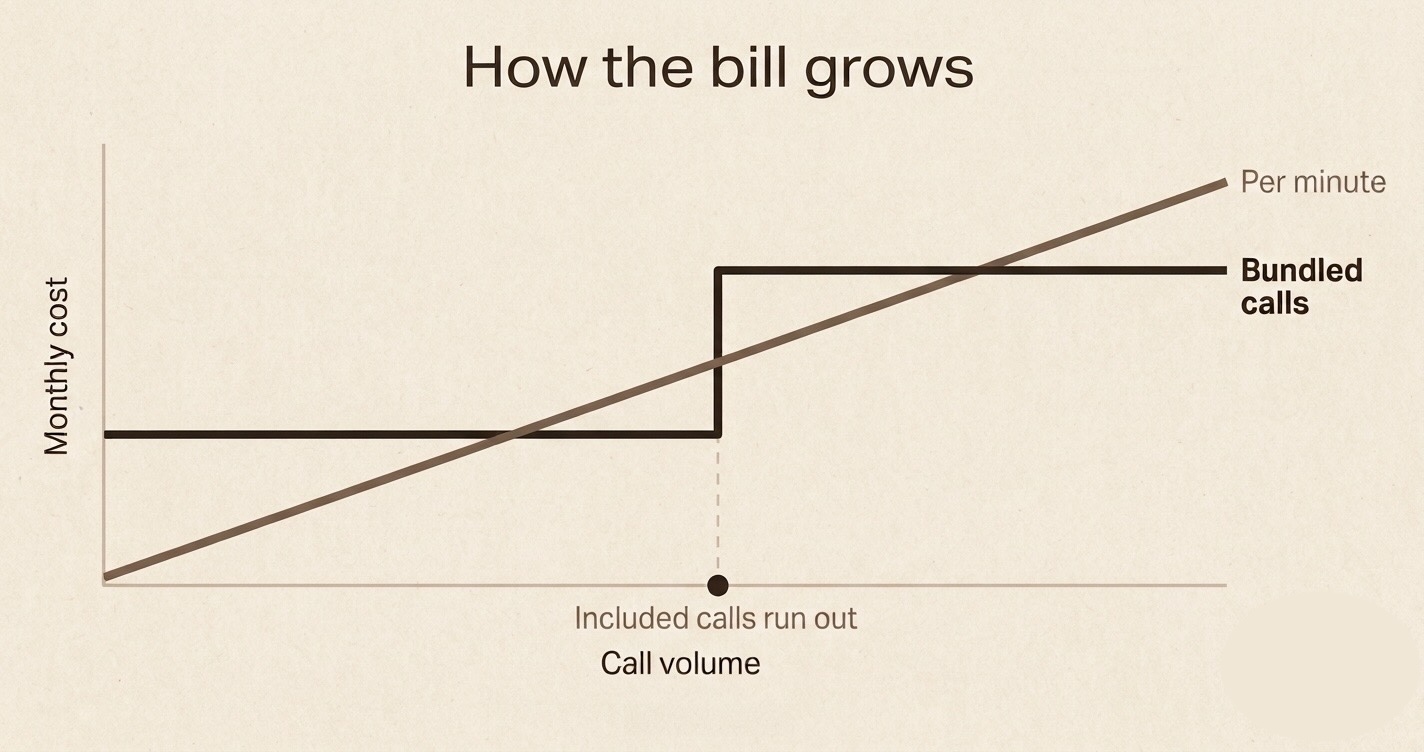
There are really only two billing shapes. Minute bundles, common on the AI only tools, are meant to scale smoothly: a busier month uses more minutes and costs proportionally more. Call bundles give you an allowance and then charge a set rate for every call past it. Smith.ai’s plans start around $300 for 30 calls and bill $11.50 for each call after that. The cruel part is the timing. That cliff hits hardest in your best month, because more calls means more leads, and the plan charges you extra at the exact moment you are winning.
Published prices, checked August 2026:
| Provider | Plan | Monthly | Included | Past the limit |
|---|---|---|---|---|
| Rosie (AI) | Rosie Professional | $49 | 250 minutes | not published |
| Rosie (AI) | Rosie Growth | $299 | 2,000 minutes | not published |
| Smith.ai (AI plus people) | Smith.ai Starter | $300 | 30 calls | $11.50 per call |
| Ruby (live people) | Ruby, 200 minutes | $720 | 200 minutes | not published |
Now look at that last column, because it is the whole point of this section. Of the four plans, exactly one tells you on its own pricing page what happens after you run out. Smith.ai publishes $11.50 a call. The others publish the monthly price and the allowance and stop there.
That is not an accusation. Plenty of companies will quote you the rate the moment you ask. But it does mean the number that decides your worst month is usually the one number missing from the page you are comparing on, and if you do not ask for it before you sign, you are agreeing to a price you have not seen.
This is the part where our own answer is different, so we will say it plainly and let you judge it. The model we build on is pass through: you open and own your AI provider account, the provider bills you directly at cost, and we add no markup on top of your call usage. There is no bundled call cliff, because there is no allowance to blow through. In our experience, agencies quietly upcharging the underlying usage is common, and owning the account yourself is how you sidestep it. The honest tradeoff, which we would rather state than hide, is that a pass through bill is a variable bill. If you need one identical number every month and cannot stomach a usage based charge, that is a real downside, and you should know it before you sign anything. You can see how we set this up on the AI Voice Receptionist page.
How much should a small business pay for an AI receptionist?
The published plans in the table above run from $49 a month at the AI only end to $720 for live people answering, and that is the honest range to budget against. The monthly figure matters less than the per call or per minute rate sitting underneath it, which is where a busy month is quietly won or lost.
The AI only tools sit at the low end and bill by the minute. The hybrid services that put real people behind the bot sit higher, because you are paying for human minutes on the messy calls. Neither is automatically right, and the deciding factor is the volume math, not the sticker price. Our full AI receptionist cost breakdown puts the published numbers from five providers side by side.
If you are still weighing software against people, we put AI, an answering service and hiring someone side by side, down to what a minute of answered phone costs under each.
Are free or cheap AI receptionists worth it for a small business?
A free or very cheap AI receptionist is worth trying only if your calls are simple and low in volume. The moment a caller asks something off script, or you start missing the calls that actually book work, the cheap option costs you the job it failed to catch, and one lost job is usually worth more than a year of the fee you saved.
Cheap tools earn their price by capping something: minutes, features, the number of questions the bot can handle before it stalls. For a business taking a handful of simple calls a week, that can be genuinely fine. For a business whose phone is its main source of work, the real cost was never the subscription. It was the booking that slipped through while you were saving forty dollars a month.
When you should not buy one
Here is the part the buyer’s guides skip: sometimes the answer is no. If you already answer nearly every call yourself, an AI receptionist is solving a problem you do not have, and your money is better spent somewhere your business is actually leaking. And if you need one fixed, identical bill every month and a usage based charge would keep you up at night, a pass through model is the wrong shape for you. Pick a fixed allowance plan, accept the cliff on your busy months, and buy the predictability instead.
But if your phone rings while your hands are full, and you have ever done the math on a job you lost to a missed call, the case tends to make itself. That is the exact situation Black Peak Studio builds for, right here in the Flathead Valley. The difference, and it is the thing this whole article has been circling, is that we do not sell you a plan and leave you to configure it. We write the agent around how your phone actually rings, and we start from what you can spend rather than from a plan sheet, which sometimes means a smaller build than you came in expecting.
See how our AI Voice Receptionist handles a busy phone, or get in touch and we will give you a straight, fixed quote after a quick call.
And before any of that, hear one. Our free demo builds an agent around your business in about thirty seconds, which is the test this whole article says to run first: does it sound like somewhere you would want to do business.